
Watering
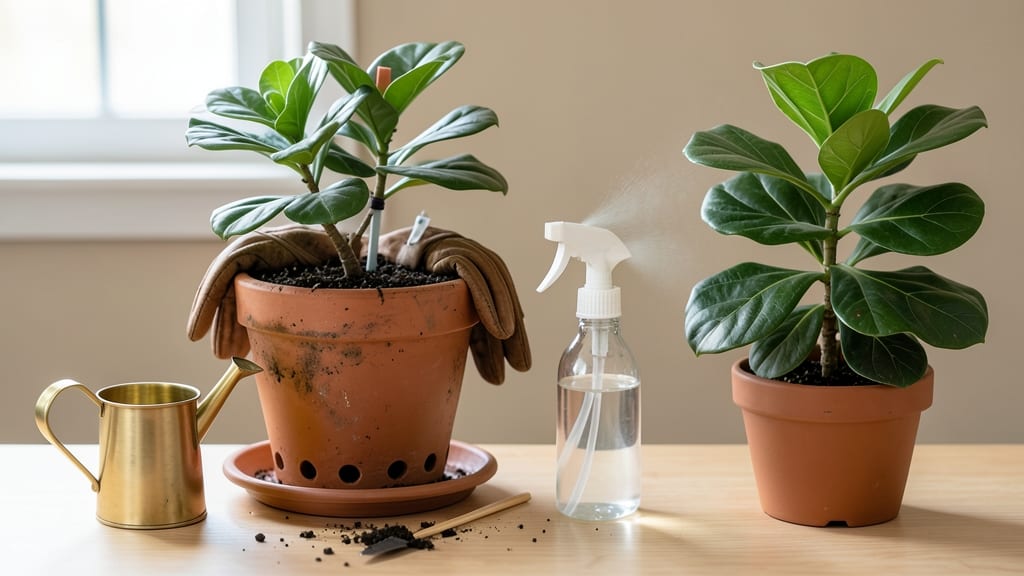
Your fiddle leaf fig's drooping leaves might signal root rot—but don't panic. 🌿 I've nursed back plants with mushy stems and yellowing foliage, and how to fix an overwatered fiddle leaf fig starts with stopping water immediately.
The key is acting fast before the roots turn to mush, then giving your plant a chance to recover with the right conditions.
First, check the roots: healthy ones are firm and white, while rotten ones smell foul and turn brown. If you see rot, trim the affected areas with clean scissors and repot into fresh, well-draining soil.
Most people overcomplicate this—just use a mix of potting soil and perlite or orchid bark to improve drainage. Water only when the top inch feels completely dry.
Within 2-3 weeks, you'll see new growth as the roots recover, and the leaves will perk up again. Keep humidity high (a pebble tray helps) and avoid letting water pool in the saucer. The goal is to mimic the plant's natural environment—dry spells between drinks and bright, indirect light.
Prevention is easier than repair: stick your finger in the soil before watering—if it's damp, wait. I learned this the hard way after losing three fiddle leaf figs to overwatering, but now I check moisture levels religiously.
Your plant can bounce back, but it needs your patience and a strict watering schedule to stay healthy long-term.
Root of the Problem
Overwatering your fiddle leaf fig (Ficus lyrata) isn’t just a minor oversight—it’s a silent killer that disrupts the plant’s delicate balance of hydration, oxygen, and nutrient uptake.
Understanding why this happens is the first step to preventing it. Below, we break down the scientific and environmental triggers that lead to soggy roots and stressed leaves.
🚨 The Culprit: Containers without drainage holes or soil that retains too much moisture.
Fiddle leaf figs are tropical plants, but their roots need aeration—just like your lungs need oxygen. When planted in pots without drainage, excess water pools at the bottom, suffocating roots.
Even with drainage holes, compacted or clay-heavy soils (like garden soil or potting mixes without perlite or sand) trap moisture, preventing roots from breathing.
Why It’s Dangerous:
- Anaerobic conditions (lack of oxygen) force roots to switch to fermentation for energy, producing ethanol and toxic byproducts that burn root cells.
- Fungal infections (like Phytophthora or Pythium) thrive in waterlogged soil, rotting roots within days.
Actionable Insight: ✅ Use a well-draining potting mix (60% peat/coir, 30% perlite/pumice, 10% orchid bark). ✅ Elevate pots on feet or saucers to prevent sitting in water.
💧 The Culprit: Watering on a fixed schedule without checking soil moisture.
Fiddle leaf figs are drought-tolerant and only need water when the top 2–3 inches of soil are dry.
If you water: - Too frequently (e.g., every 3–5 days in warm weather), - Without accounting for humidity (high humidity = slower evaporation = wetter soil longer), - Using the "calendar method" instead of the finger test,
you’re essentially drowning the roots. Overwatering is the #1 cause of root rot in this plant.
Why It’s Dangerous:
- Osmotic stress: Excess water dilutes the soil’s nutrient concentration, starving roots of essential minerals like potassium and magnesium.
- Root suffocation: Healthy roots need 10–20% air space in soil. Soggy conditions replace oxygen with water, leading to cell death within 24–48 hours.
Actionable Insight: 👉 Stick your finger in the soil—if it’s damp past 1 inch, wait. Use a moisture meter for precision. 👉 Water deeply but infrequently—soak until water drains from the bottom, then wait until the topsoil is dry.
🌿 The Culprit: Placing your fiddle leaf fig in low-light conditions with high humidity.
This plant is a light lover—it needs bright, indirect light (like an east or north-facing window) to regulate its transpiration rate (how it releases water vapor).
In low light: - The plant photosynthesizes less, reducing its ability to process excess water. - Humidity traps moisture in the soil longer, slowing evaporation.
Why It’s Dangerous:
- Stunted transpiration means water lingers in leaves and soil, increasing bacterial leaf spot and root rot risk.
- Weakened vascular system: The plant can’t transport water efficiently, leading to yellowing leaves (chlorosis) and drooping.
Actionable Insight: 💡 Move to brighter light (avoid direct sun, which burns leaves). 💡 Use a hygrometer—ideal humidity is 40–60%. If your home is humid, reduce watering frequency.
🏺 The Culprit: Using pots that are too large or made of non-breathable materials.
A pot that’s too big holds excess moisture because the soil dries out slower. Meanwhile, glazed ceramic or plastic pots trap humidity against the roots, creating a greenhouse effect that accelerates rot.
Why It’s Dangerous:
- Slow-draining soil: Large pots stay wet for weeks, giving fungi and bacteria time to colonize.
- Temperature fluctuations: Non-breathable pots can cause root temperature stress, weakening defenses against pathogens.
Actionable Insight: 🔹 Choose pots 1–2 inches larger than the root ball (max). 🔹 Opt for terracotta or fabric pots—they allow evaporative cooling and better airflow.
🚰 The Culprit: Using hard water, chlorinated water, or water with high salts/minerals.
Fiddle leaf figs are sensitive to fluoride, chlorine, and sodium in tap water. Over time, these build up in the soil, disrupting nutrient uptake and increasing soil salinity, which stresses roots.
Why It’s Dangerous:
- Root burn: Excess salts denature proteins in root cells, causing necrosis (cell death).
- pH imbalance: Hard water raises soil pH, locking out micronutrients like iron and manganese, leading to yellow leaves with green veins.
Actionable Insight: 💧 Let tap water sit for 24 hours to off-gas chlorine. 💧 Use filtered or distilled water if your tap water is hard (test with a TDS meter—aim for <100 ppm).
❄️ The Culprit: Watering the same amount year-round, ignoring the plant’s dormancy phase.
In winter, fiddle leaf figs grow slower and transpire less (releasing less water vapor). If you keep watering like summer:
- Soil stays wet for days or weeks.
- Root respiration slows, but decay speeds up in cool, damp conditions.
Why It’s Dangerous:
- Cold + wet = fungal paradise: Rhizoctonia and Fusarium thrive in 50–70°F (10–21°C) wet soil.
- Nutrient lockout: Cooler temps reduce microbial activity, so beneficial bacteria can’t break down excess salts.
Actionable Insight: 🌡️ Water 50% less in winter—check soil moisture every 10–14 days. 🌡️ Move to a warmer spot (65–75°F / 18–24°C) if possible to speed up drying.
Overwatering isn’t just about how much you water—it’s about how the plant experiences water. By fixing drainage, light, pot choice, and water quality, you’re not just saving roots—you’re restoring the plant’s natural balance.
🔥 Pro Tip: If your fiddle leaf fig is already overwatered, don’t panic—the next section covers how to revive soggy roots without losing leaves.
Revive Your Fig with These Fixes
Now that you know the signs and causes of overwatering, it’s time to take action! The good news is that with the right steps, your fiddle leaf fig can bounce back—even if it’s looking a little worse for wear.
Below, we’ll break down practical solutions tailored to the most common causes of overwatering, plus tips to keep your plant thriving long-term.
If your fiddle leaf fig’s leaves are yellowing, wilting, or falling off, it’s likely suffering from root rot or waterlogged soil. Here’s how to nurse it back to health:
1️⃣ Stop Watering Immediately
🔥 First rule: No more water until the soil is dry.
- Let the top 2–3 inches of soil become completely dry before watering again.
- If the pot feels heavy, it’s still too wet—wait longer.
2️⃣ Check the Roots (Gently!)
👨🍳 Time to play detective.
- Carefully remove the plant from its pot and inspect the roots.
- Healthy roots are firm and white or light tan.
- Rotten roots are mushy, black, or smell foul.
✨ Pro Tip: If roots look bad, don’t panic—you can still save your fig!
3️⃣ Trim the Damaged Roots
🔪 Surgical precision saves lives.
- Use sterilized scissors or pruning shears to cut off any black, mushy, or squishy roots.
- Keep only the firm, white roots—they’re the ones that can regrow.
4️⃣ Repot in Fresh, Dry Soil
🍳 New home, new start.
- Choose a well-draining potting mix (like a cactus/succulent blend or a fiddle leaf fig-specific mix).
- Add a layer of perlite or orchid bark at the bottom for extra drainage.
- Repot your fig, ensuring the remaining roots are covered but not buried too deep.
5️⃣ Adjust Your Watering Routine
💧 Less is more—always.
- Water only when the top 2–3 inches of soil are bone dry (stick your finger in to test!).
- Bottom-watering (placing the pot in a tray of water for 10–15 minutes) can help prevent overwatering.
If your leaves are brown and crispy (not just yellow), the damage might be more severe, but recovery is still possible.
1️⃣ Prune the Dead Leaves
✂️ Clean up to encourage new growth.
- Snip off fully brown, crispy leaves at the base with clean scissors.
- Avoid cutting into healthy green tissue—this can stress the plant further.
2️⃣ Boost Humidity (Gently)
🌡️ Fiddle leaf figs love moisture in the air.
- Place a humidifier nearby or set the pot on a tray of pebbles with water (ensure the pot isn’t sitting in water).
- Mist the leaves lightly 1–2 times a week (avoid soggy leaves).
3️⃣ Fertilize Lightly (If Needed)
💪 Feed it right for recovery.
- Wait 4–6 weeks after repotting before fertilizing.
- Use a balanced, diluted fertilizer (half-strength) every 4–6 weeks in spring/summer.
The best way to fix overwatering? Don’t do it again! Here’s how to keep your fiddle leaf fig happy and hydrated—without drowning it.
💡 Use the Right Pot
- Terracotta pots (unglazed) wick away moisture faster than plastic.
- Ensure the pot has drainage holes—no exceptions!
🎯 Watering Schedule Cheat Sheet
| Season | Watering Frequency | How to Check |
|---|---|---|
| Spring/Summer | Every 7–10 days | Top 2–3" soil dry |
| Fall/Winter | Every 3–4 weeks | Top 3–4" soil dry |
| Humid Climates | Less often | Stick test + pot weight |
✨ Pro Tips for Long-Term Success
- Group plants together—they increase humidity naturally.
- Avoid ice cube watering (trendy but risky—stick to room-temp water).
- Rotate your plant weekly for even light exposure (prevents leggy growth).
Your fiddle leaf fig may take 4–8 weeks to show signs of recovery, but with patience and the right care, it’ll be back to its lush, leafy self. Stay consistent, and don’t give up—your plant’s got fight left! 🌿💚
Frequently asked questions
How long does it take for a fiddle leaf fig to recover from overwatering?
Recovery time varies, but most plants show improvement within 4-8 weeks with proper care. The key is patience—focus on keeping soil dry, providing bright indirect light, and avoiding stress. Some plants may take up to 3 months to fully bounce back, especially if root damage was severe.
Can I save my fiddle leaf fig if the roots smell bad?
Yes, but you'll need to act fast! If roots smell foul (like rotten eggs), trim all mushy black sections with sterilized scissors, then repot in fresh, dry soil. The plant can regrow healthy roots from the remaining firm white roots. Just be prepared for slower recovery during the healing process.
What if my fiddle leaf fig has no leaves left after overwatering?
Don't give up! Even leafless stems can regrow with proper care. Keep the soil dry, place the plant in bright indirect light, and maintain high humidity. New growth typically emerges from the stem within 6-12 weeks, though it may take longer for full foliage to return.
Is it better to underwater than overwater fiddle leaf figs?
While both extremes are harmful, fiddle leaf figs are more forgiving of underwatering than overwatering. They can survive weeks without water if needed, but root rot from excess moisture kills much faster. The key is finding that "just right" balance—water only when the top 2-3 inches of soil are completely dry.
How can I tell if my fiddle leaf fig is getting enough light after recovery?
Look for these signs: healthy leaves should be deep green with no yellowing or brown edges. If your plant stretches toward light (etiolation) or develops small leaves, it needs more brightness. East or north-facing windows are ideal—just avoid harsh direct sunlight that can scorch the leaves.